
BUILDING GIANTS follows the race to build the world’s next generation of engineering wonders – structures and machines that are more ambitious and more advanced than anything seen before. Eight action-packed episodes track the tension and drama as engineers push technology to its limits, and strive to construct new marvels for the modern age.
Each episode follows the construction of a giant engineering super structure. We get in close with the workers to experience the freezing conditions, vertigo-inducing heights, and mammoth scale of these trail-blazing projects. While spectacular CGI animation reveals the innovative technology that makes these daring structures possible.
The series features some of the most ambitious engineering projects of our time. In Atlanta, Georgia, engineers constructing the world’s most advanced sports stadium must build a vast roof that opens and closes like the iris on a camera. Beneath Copenhagen, four giant boring machines will excavate nineteen miles of tunnels to create the city’s new metro. At a French shipyard, workers assemble one of the largest and most advanced cruise ships ever built. While in Venice, engineers race to construct a five-billion-pound barrier to protect the city from floods.
To speed construction of the world’s largest church – Gaudí’s masterpiece the Sagrada Familia – stonemasons in Barcelona break with tradition and deploy new technology. In New York, developers must find a way to construct one of the city’s tallest buildings on a tiny plot of land. While, in Norway, engineer Dagrunn Kaasen and her team must battle ferocious winds to build the longest suspension bridge in the Arctic Circle.
The series explores what it takes to build the masterpieces of the modern world. We meet the engineers and workers battling to complete these vast super structures on time, and on budget. We see the problems they face and how they solve them. As we follow each project, from concept to completion, we reveal through dramatic CGI animation the ingenious technical solutions that enable engineers to build these giants of our age.
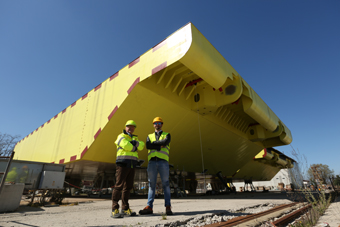
Venice is hit by almost 100 floods each year, gradually destroying the fabric of this historic city, but now engineers are building a vast sea barrier that will protect the Venetian lagoon from high tides and prevent the most severe floods. Already 15 years in the making and costing almost 5 billion pounds this barrier, called ‘MOSE’, will be completely unique - a system of 78 steel gates built into the seabed that can be raised when the tide threatens the city.
We visit the shipyard in Croatia building the gates and meet the team who must precision cut and weld the giant sheets of steel that make up each 330 ton gate. Once complete, we see the gates loaded onto a barge that will be towed to Venice, but as each gate is rolled onto the floating platform it could capsize, so the team use an ingenious system of ballast tanks inside to balance the barge.
Back in Venice, we meet conservationist, Paolo Pagnin, who shows us how the rising waters soak the ancient brickwork, depositing corroding salt that is eating away the city’s buildings. Out at the lagoon inlet, the gates arrive from Croatia and must now be installed on the seabed by engineer, Francesco Zago. He uses a unique crane, called the ‘Grasshopper’, to lower the first gate into place, although an invasion of crabs threatens the operation! Project Leader, Dario Berti, reveals how Venice’s seagulls are unexpectedly attracted to the newly delivered gates and seem hell-bent on eating the protective yellow paint.
We gain access to the MOSE control centre and show how they will decide when to deploy the barriers using a network of offshore instruments that predict high tides. Finally, we see the team locking the inlet’s last gate into place and testing the system.
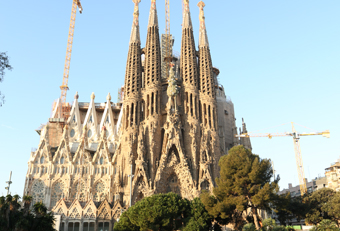
A build taking over 140 years finally nears completion, as the engineers and architects of Barcelona’s Sagrada Familia attempt to raise the six central towers that will make it the world’s tallest church. Already dominating the city’s skyline, soaring over 100 metres tall and attracting 4.5 million visitors each year, the stone towers will push the church’s height above 170 metres.
Sagrada Familia’s original maverick architect, Antoni Gaudî, died almost 100 years ago and many of his plans and models were lost, so the team must follow design clues helping them to realise Gaudí’s vision. Chief Architect today is Jordi Fauli, who faces a major problem, Gaudí used the distinctive multi-coloured local stone to build the church, however there is none left. So he must replicate the look by sourcing stone from quarries around the world, including a quarry in Lancashire, where we meet the team blasting the rock.
To build the towers, Head of Construction, Jaume Torreguitart, will build 856 prefabricated stone panels and hoist each one to the top of Sagrada Familia, then slot them into place. We follow the first level being installed that will prove this unique construction method works, but they hit trouble as the bolts do not align. High winds also threaten to shut down Jaume’s operation. The towers must be earthquake proof, so we discover the ingenious secret steel skeleton, built into the panels, that braces the structure. We meet the highly skilled craftsmen hand-finishing the stone reliefs that will adorn the towers and learn how they bring the stone to life. The church’s stunning stained glass windows have been known to bring visitors to tears, they are designed by a father and son team who reveal their secrets.
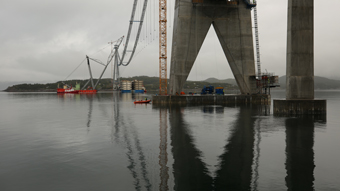
This episode follows an international team of engineers and construction workers as they attempt to build the longest suspension bridge within the Arctic Circle. The giant 276-million-pound Hålogaland Bridge will cross the stunning Rombak Fjord, providing safer, faster access to the north of the country from the busy industrial city of Narvik.
The team from Norway and China is overseen by project manager Dagrunn Kaasen, an engineer with 30 years’ experience. But this will be her first ever bridge build. The documentary follows Dagrunn and her team as they race to install over 11,000 miles of steel wire that will form the bridge’s giant main cables. Each cable needs to be anchored 130 feet deep into the heart of the mountains on either side of the fjord. We follow the workers as they struggle to install 30 huge steel deck sections using a giant floating crane, each section needs to be locked into position at precisely the right angle, or the deck and towers won’t align.
The team’s ultimate challenge is battling the weather. In this part of the world temperatures rise and fall by 60 degrees across the year and, with minus 30-degree winters, Dagrunn must finish the deck installation before the Arctic winter weather arrives!
Building a bridge of this scale in this part of the world is no mean feat. We witness the team fight through ferocious storm winds that wreak havoc with the build, whilst working 500 feet above the freezing water. And we learn how architects have designed the bridge to withstand the hostile environment to take on Mother Nature’s worst!
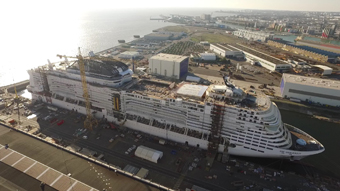
In this episode we follow an international team of engineers and workers as they attempt to build one of the largest and most advanced cruise ships in the world. Named ‘Meraviglia’, this nautical leviathan is built from 35,000 tonnes of steel, stretches 1,036 feet long and will carry over 5,700 passengers.
Site Manager Gaetano Rolando, a seasoned naval engineer has been tasked with overseeing the construction of the giant vessel, but this is his first ever cruise ship. We follow Gaetano and the team as they race to construct the vessel from 50 giant sections – called ‘Mega Blocks’, install over 2,200 cabins and design and test a mammoth bespoke LED screen ceiling – the longest LED screen ever built on a ship! Making the construction of this brand new class of cruise ship a challenge like no other.
We watch as the cruise liner is transformed from blank sheets of steel into a £725 million ocean going goliath that pushes the boundaries of ship design and construction. Built on the west coast of France, in one of the largest shipyards in Europe, engineers must overcome adversity to realise this never-before attempted design. To ensure the ship works and is safe to carry over 5,000 people, we witness the vessel put through its paces in a series of gruelling tests out in the open sea.
The clock is ticking. The ship’s maiden voyage has already sold out and Gaetano and the team must finish its construction in time to see the vessel arrive at its star-studded launch ceremony before its first passengers board.
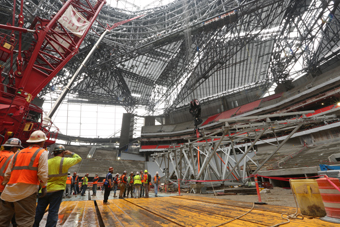
This episode goes behind the scenes with the team building the world’s most advanced sports arena – the 1.2-billion-pound Mercedes Benz Stadium in Atlanta. It will hold up to 75 thousand fans, incorporate the world’s biggest sports screen – a 360-degree ‘Halo Board’ and feature the most ambitious retractable roof ever built. Powered by 96 motors, weighing three-and-a-half thousand tons and made of eight vast steel ‘petals’, this roof will open and close like a camera iris.
Facing unprecedented engineering challenges, the construction team has no time to waste. This ground breaking arena must be open for the start of the football season. It’s down to Avery Martin and his team of ironworkers to build the arena. Their first challenge is to find a way to jack down the 15,000 ton fixed roof trusses. Working 300 feet above the ground, they then face deadly winds as they battle to control the vast steel sections of the retractable roof, raised into position by America’s biggest crawler crane.
We will discover the ingenuity required to design, build and install the 62,000 square foot Halo Board that must withstand all the weather Mother Nature can throw at it. As the complex mechanised roof structure nears completion, our cameras are there to capture the critical first test to close the roof. Nobody knows whether this untested design will actually work. As the opening game of the season looms, the crew face a race against time and weather to complete this epic stadium.
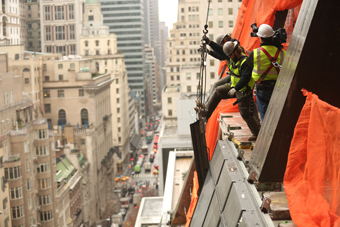
New York City is so crammed with skyscrapers that there’s scarcely space left to build on. This creates a unique challenge for developer Tim Flynn. At 53 West 53rd street, Tim plans to construct an 82-storey skyscraper that will add 50,000 square feet to the Museum of Modern Art and provide luxury apartments with stunning views of Central Park. The ambition is for a giant skyscraper – one of the tallest in the city – but Tim must build it on a tiny plot of land scarcely large enough to park a few cars.
We follow the engineers and workers as they meet the challenge of building this uniquely tall and thin tower. They can’t build it the traditional way, with columns inside the building, as these would take up precious floor space. Instead, workers must construct a diagonal framework on the outside of the building – the largest of its type ever attempted.
But as the building rises, the small site presents another challenge. Because the building tapers inwards, there is no space on the upper floors to put a crane, and without a crane they can’t build higher. In a vertigo-inducing, palm-sweating scene, we see the engineers’ ingenious solution – workers construct a platform outside the building, high above the street below, and assemble their crane on this.
Down on New York’s streets, we follow concrete truck driver, Curt Reinecke. With no concrete manufacturing plant in Manhattan, he must deliver his load of concrete from the borough of Queens 13 miles away. But with just 90 minutes to get the concrete on site before it goes off, every delivery is a race against time.
With the completion deadline looming, steelworker, Frank Mahoney leads the team installing the skyscraper’s external skin. The glass and aluminium façade is fixed to the building using a technique pioneered by one of New York’s most iconic skyscrapers – the Flatiron Building, constructed over 100 years earlier.
With dramatic CGI animation, this film reveals the ingenious engineering that will enable 53 West 53rd to rise 1,050 feet above the New York streets, and become one of the most city’s most radical and elegant skyscrapers.
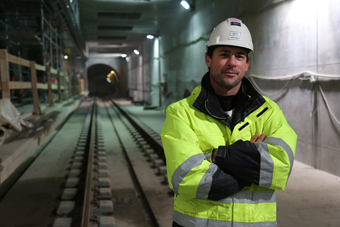
This episode follows an international team of engineers and construction workers as they attempt to build a brand new epic metro line underneath the Danish capital of Copenhagen. Called “Cityringen”, this ambitious project is the largest feat of engineering the city has seen for over four hundred years.
The programme follows the tunnelling project manager, Valerio Violo and his team as they race to tunnel between 17 brand new stations using four giant tunnel boring machines. They will excavate over nineteen miles of new train tunnels, lay 22 miles of track, dig through toxic earth and navigate their way under the capitals the busiest railway station – whilst it remains open!
Across town another team is busy finalising and testing the 39 new driverless trains that will run on the new line. Costing over £2.5 billion this giant Cityringen project will bring 90% of the city’s population within a 10-minute walk to a station and will help alleviate congestion on the roads.
But building a project of this magnitude isn’t without its challenges; as we follow the team they face a flooding station as a giant tunnelling machine is about to break through into a new platform and fears are realised as work underneath the city’s busiest active railway station causes alarms to trigger.
| Executive Producers | Carlo Massarella , Dan Kendall |
| Series Producer | Andrew Barron |
| Line Producer | Farne Sinclair |
| Junior Production Manager | Olivia Badnell |
| Researcher | Frank Jordan |